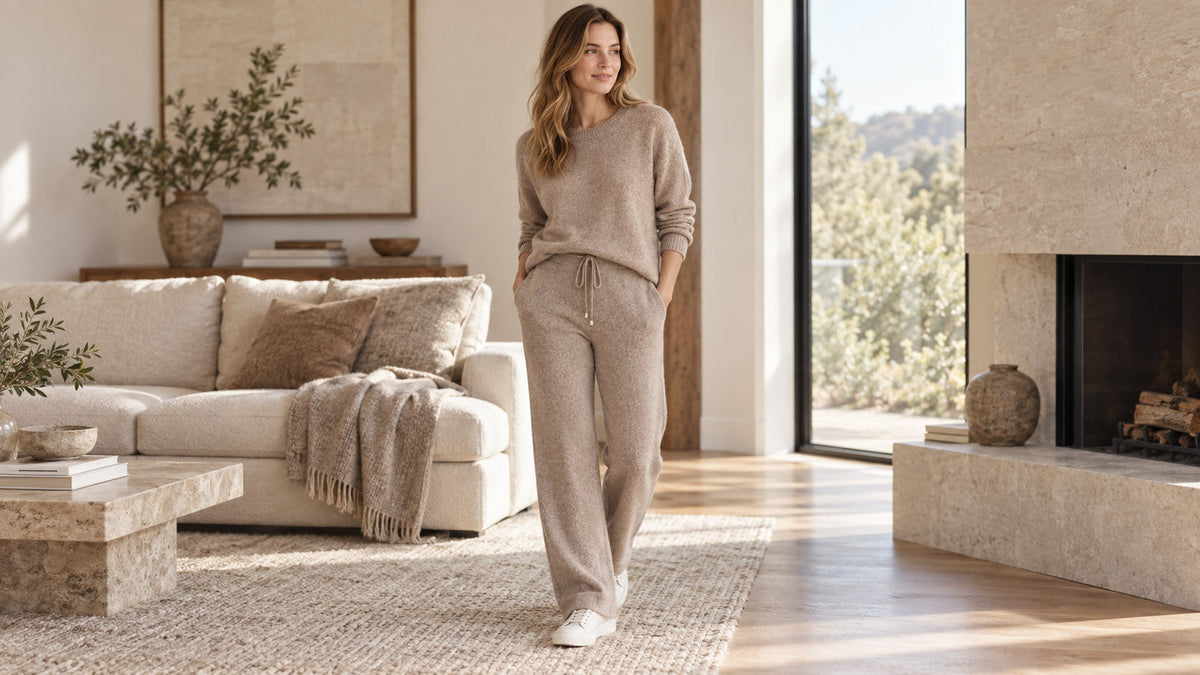
Are Cashmere Pants Warm Enough for Winter?
When the temperature drops, your instinct is to reach for heavier fabrics — wool, fleece, insulated layers. But cashmere offers something different: warmth that arrives without weight, without bulk, and without the stiffness that makes heavier trousers uncomfortable during a long day. The question is not whether cashmere pants are warm — they are — but how warm, in which conditions, and what you can do to extend their thermal range through layering. This guide breaks it down season by season, so you know exactly what to expect.
How Cashmere Insulates — the Science of Warmth
Cashmere's warmth comes from the structure of the fiber itself. Each cashmere fiber is extremely fine — typically 14 to 19 microns in diameter — and has a natural crimp that creates tiny air pockets within the yarn. These air pockets trap body heat and form a layer of still, warm air between your skin and the outside environment. This is the same insulation principle used by down jackets and thermal sleeping bags, but at a much finer scale.
What makes cashmere remarkable is the ratio of warmth to weight. Because the fibers are so fine, a relatively thin layer of cashmere provides significant insulation without the bulk of thicker materials. A pair of cashmere pants that feels light and fluid against your legs may be retaining as much heat as a heavier pair of lined wool trousers — while allowing far greater freedom of movement and a more refined silhouette.
How Does Cashmere Compare to Wool for Warmth?
Cashmere fibers are finer than merino wool fibers, which means they create more air pockets per unit of weight and therefore insulate more efficiently. Gram for gram, cashmere provides more warmth than standard wool — though the exact difference depends on the gauge, ply and density of the specific garment. A heavyweight merino trouser may feel warmer than a lightweight cashmere legging simply because there is more material, but at comparable weights, cashmere's insulating efficiency is consistently higher. It is also significantly softer against the skin, which matters when the fabric sits directly against bare legs.
Cashmere Pants Through the Seasons

The versatility of cashmere pants as a year-round garment surprises many people. Their thermal behaviour adapts to the season more dynamically than most fabrics — keeping you warm when it is cold while remaining breathable enough to wear in milder temperatures.
In early autumn, cashmere pants provide just enough insulation for cool mornings and chilly evenings without overheating during a mild afternoon. They work beautifully on their own with a light knit or a cotton shirt — no additional layering needed. As the temperature drops into late autumn and early winter, they become a base layer of warmth beneath a coat, keeping your legs comfortable during a commute or an outdoor walk without adding the bulkiness of lined trousers.
Are They Warm Enough for Deep Winter?
In moderate winter conditions — temperatures above -5°C with typical urban exposure — cashmere pants worn beneath a long coat provide comfortable warmth for most daily activities: walking to work, running errands, dining out. The key is that they insulate well at the points of contact — thighs, hips, waistline — where body heat concentrates.
In extreme cold — sub-zero temperatures or prolonged outdoor exposure — cashmere pants alone may not be sufficient. This is where layering extends their range. A pair of thin thermal tights or silk base-layer leggings beneath cashmere pants creates a dual-insulation system without visible bulk. The base layer traps heat close to the skin; the cashmere provides a second layer of insulation on top. This combination handles temperatures well below freezing while maintaining the elegant silhouette that makes cashmere pants worth choosing over padded alternatives.
Which Styles Are Warmest?

Not all cashmere pant styles offer the same level of warmth. The difference comes down to knit density, weight and coverage.
Higher-gauge, denser knits trap more air per unit of surface area and therefore insulate more effectively than looser constructions. A pair of tapered joggers in a dense gauge will feel warmer than a pair of lightweight wide-leg trousers in a more open knit, even when both are made from the same grade of cashmere. Our quality guide explains how gauge and ply affect performance.
Cashmere leggings offer close-fitting insulation that works like thermal wear — the fabric sits directly against the skin, eliminating the air gaps that let cold in. They are among the warmest cashmere pant options for winter because there is no space between the fabric and your body for cold air to circulate. Wide-leg pants, while beautiful, allow more airflow between the legs and are better suited to moderate cool weather or layered combinations.
Does Colour Affect Warmth?
In practical terms, no. Darker colours absorb marginally more radiant heat from sunlight, but the effect is negligible compared to the insulation provided by the fiber itself. Choose your colour based on your wardrobe and your preference — the warmth comes from the cashmere, not the shade. Our styling guide covers colour pairing for every season and occasion.
Breathability — Warmth Without Overheating

One of cashmere's most underrated qualities is its natural breathability. Unlike synthetic insulating fabrics, which trap moisture and heat indiscriminately, cashmere fibers absorb and release moisture vapour from the skin. This means your legs stay warm without becoming clammy — a particular advantage during a day that moves between a heated office and a cold street.
This moisture management also makes cashmere pants practical for travel in cold climates. The temperature inside an airport, a train, or a restaurant may be 20 degrees warmer than outside, and a fabric that cannot breathe makes these transitions uncomfortable. Cashmere adjusts: it insulates in the cold and releases heat as the environment warms, keeping you in a narrow band of comfort throughout the day. Our travel guide explores this advantage in detail.
Can You Wear Cashmere Pants in Spring or Summer?

Yes — particularly lighter-weight styles. A fine-gauge cashmere legging or a lightweight jogger in a pale colour works beautifully on cool spring evenings and in air-conditioned summer environments. The breathability prevents overheating, and the softness against the skin is unmatched by cotton or linen alternatives. The versatility extends to layering too: cashmere pants beneath a linen blazer on a spring evening is a combination that balances warmth and lightness with effortless elegance.
Warmth That Moves with Your Life
Cashmere pants provide a kind of warmth that is difficult to find elsewhere — present but never oppressive, visible in its softness but invisible in its weight. They keep you warm on a winter commute, comfortable in a heated office, and at ease during a long dinner on a cool evening. The insulation works because of the fiber's structure, not its bulk, and this is what makes cashmere pants a genuinely practical choice for cold weather rather than a compromise. To find the weight, gauge and style that suits your climate, explore our women's cashmere pants collection — where every piece is designed to keep you warm without asking you to sacrifice anything in return.