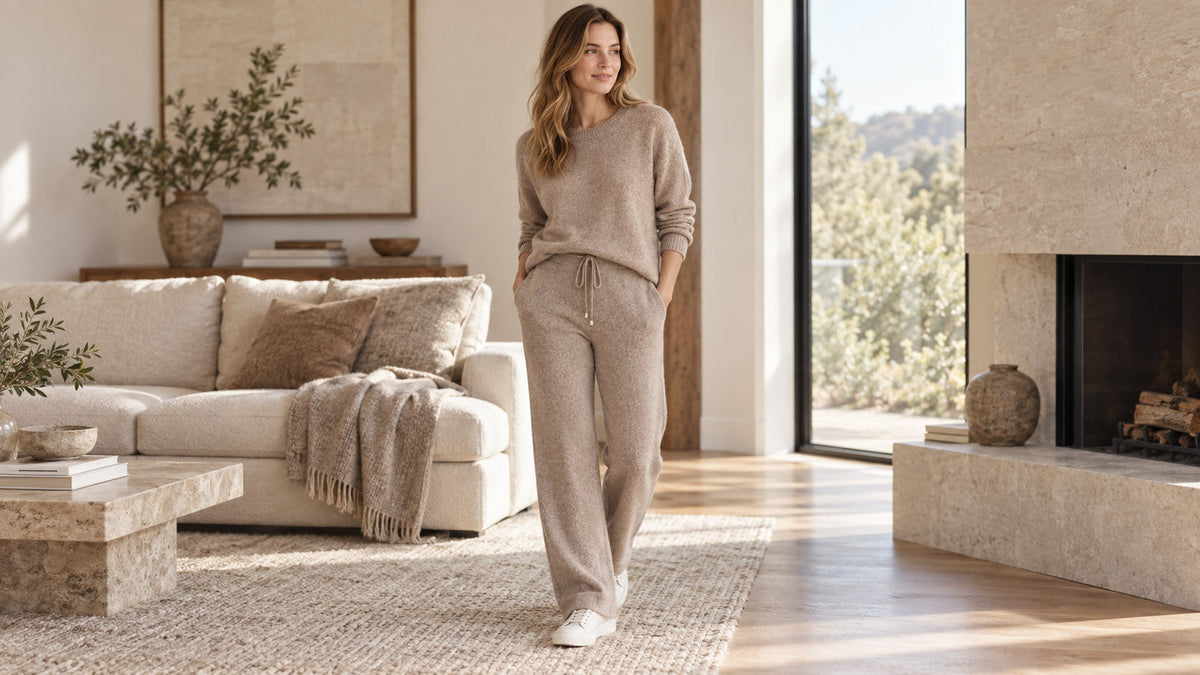
Do Cashmere Pants Stretch or Lose Their Shape?
You have been wearing your cashmere pants all day, and when you glance down, the knees are bagging, the seat feels looser than it did this morning, and the waistband has eased. Is something wrong? Almost certainly not. Cashmere is a knitted fabric, and all knits relax with wear — it is part of how the fiber works, not a sign of failure. Understanding why cashmere stretches, which areas are most affected, and how to restore the original shape transforms a moment of concern into a routine part of owning something beautiful.
Why Cashmere Relaxes with Wear
Cashmere fibers have a natural crimp and elasticity that allows the yarn to stretch under tension and recover when released. This is what gives cashmere its beautiful drape and its ability to move with your body rather than restricting it. However, sustained tension — the kind created by bending your knees, sitting for hours, or the pull of gravity on the waistband — gradually extends the fibers beyond their resting state.
The degree of stretch depends on several factors: the gauge of the knit, the ply of the yarn, the tightness of the twist, and the specific construction of the garment. A dense-gauge, two-ply cashmere pant with a firm twist will hold its shape more stubbornly than a loose-gauge, single-ply pant with a soft twist. But even the most structured cashmere will relax to some degree over a full day of wear — this is the fiber behaving as it should.
Is Some Stretching Normal?
Yes — and expected. A degree of natural relaxation after wearing is universal across all knitted garments, not specific to cashmere. The question is not whether your pants will stretch, but whether they recover. Quality cashmere that is properly cared for will bounce back to its original dimensions after washing and flat drying. If the fabric stays permanently distorted after a gentle wash, the construction may lack the resilience needed for a garment designed for repeated wear.
Where Cashmere Pants Stretch the Most
Stretching is not uniform — it concentrates at the points of greatest mechanical stress. Knowing these areas helps you anticipate the behaviour and manage it.
The knees are the most visible stretch zone. Every time you bend your knee — sitting, climbing stairs, walking — the fabric extends across the joint. Over a full day, this repeated extension leaves a visible pouch or bagging at the knee area. The seat is next: sitting places sustained downward and lateral pressure on the fabric, gradually widening and loosening the knit across the back of the pants.
The waistband stretches differently depending on construction. An elastic waistband will lose some of its recovery over time as the elastic fibers fatigue. A knitted rib waistband stretches less aggressively but may ease slightly with prolonged wear. A flat, folded waistband with no elastic holds its dimensions most consistently but offers less give when you sit or move.
Do Cashmere Leggings Stretch More Than Other Styles?

Leggings experience more stretch because they sit closer to the body and are under constant light tension across a larger surface area. Every movement — walking, sitting, bending — engages the knit directly. However, leggings are also designed with this in mind: the gauge is typically denser and the yarn is often spun with a tighter twist to accommodate the demands of a close-fitting silhouette. Wide-leg and straight-leg pants experience less overall stretch because the fabric hangs with more ease, but the knee and seat areas still relax through the same mechanics.
How to Restore the Original Shape

The most effective way to reset stretched cashmere is a gentle hand wash. When cashmere fibers absorb water, they swell slightly and contract back toward their original dimensions. Washing in cool water, pressing out excess moisture with a towel roll, and then reshaping the garment while damp allows you to guide the fibers back to their intended proportions.
While the pants are still damp, pay particular attention to the knee area and waistband. Gently compress the bagged knees back to their original width, smooth the waistband to its intended circumference, and adjust the overall leg length. Cashmere is most pliable when damp, so this is your window to correct any distortion. Lay flat to dry, and the fibers will set in the restored position. Our washing guide covers the full process in detail.
Can You Reshape Cashmere Pants Without Washing?
For minor knee bagging, a light steam can help. Hold a steam iron a few centimetres above the stretched area — never touching the fabric — and allow the steam to penetrate the fibers. The moisture and warmth relax the yarn, and you can gently press the fabric back toward its original shape. This is a quick fix between washes, not a replacement for a full reset, but it works well for maintaining a polished appearance during the day.
Which Constructions Resist Stretching Best?

If shape retention is a priority, look for specific construction details when choosing your cashmere pants. A denser gauge — more stitches per inch — produces a firmer fabric that resists stretching more effectively than a loose, open knit. Two-ply yarn holds its structure better than single-ply because the twist between the two strands creates internal tension that counteracts external force.
Reinforced waistbands — those with internal elastic, a ribbed construction, or a folded channel — maintain their circumference more reliably than simple knitted edges. Some styles feature a drawstring in addition to elastic, which allows you to adjust the fit as the garment relaxes throughout the day. Flat seams and linked construction at the knees and crotch also contribute to overall stability, distributing stress across a wider area rather than concentrating it at a single point. Our fit guide explains how to choose a size that accounts for natural relaxation without starting too loose.
Does the Gauge Number on a Label Tell You Anything?
Yes — it tells you the knitting density. A higher gauge number means a finer, tighter knit; a lower gauge means a chunkier, more open construction. For pants, a mid-to-high gauge — typically 12 gauge or above — provides the best balance of softness and structural integrity. A 7-gauge pant will feel beautifully soft but will stretch and relax more noticeably than a 14-gauge alternative. The gauge affects not just stretch resistance but also drape, warmth and overall appearance.
Living with the Way Cashmere Moves
Stretching is not a flaw in cashmere — it is part of what makes the fabric feel so comfortable against the skin. The same elasticity that causes knee bagging is what allows cashmere pants to move with your body without restriction, to sit comfortably for hours, and to drape rather than constrain. A gentle wash restores the shape, the fabric resets, and the cycle begins again — each time, the cashmere growing softer and more refined. To find pants constructed for both comfort and resilience, explore our women's cashmere pants collection, where every style is built to recover as beautifully as it wears.