How to Tell If a Cashmere Scarf Is Good Quality
A cashmere scarf that feels extraordinary on day one should still feel extraordinary after years of use. The difference between a piece that softens beautifully with time and one that pills, sheds and loses its shape within weeks comes down to fiber quality, construction and finishing — details that are not always visible at first glance but become impossible to ignore over time. Whether you are choosing your first cashmere scarf or comparing options online, knowing what separates genuine quality from clever marketing protects your investment and ensures every piece earns its place around your neck.
What Makes Cashmere Fibers Exceptional?

Not all cashmere is the same. The raw fiber is graded according to its fineness, length and purity — three characteristics that determine how the finished fabric looks, feels and performs. Grade A cashmere uses fibers measuring roughly 14 to 15.5 microns in diameter, which is exceptionally fine. These thinner fibers feel softer against the skin, trap more air for warmth, and create a smoother, more even surface when woven or knitted.
Fiber length matters just as much. Longer fibers — typically 34 to 36 millimeters — hold together more securely within the yarn, reducing the number of loose ends that work their way to the surface as pills or shed fibers. When a brand specifies long-staple cashmere, it signals a deliberate choice of raw material that directly affects how the scarf ages. Shorter fibers shed more readily, which is why some scarves begin pilling within the first few wears while others remain smooth for months.
Is Mongolian Cashmere Better?
Mongolian and Inner Mongolian cashmere are widely regarded as among the finest available, largely because the extreme cold of the region produces goats with an exceptionally dense, fine undercoat. However, origin alone does not guarantee quality — processing, sorting and spinning matter equally. A scarf made from carefully sorted Mongolian fibers that have been combed rather than sheared, then spun with minimal chemical treatment, will outperform one that uses the same origin fiber but rushes the manufacturing process. Origin is a useful indicator, but the complete chain — from goat to finished scarf — determines the quality you feel.
Two-Ply, Weave Density and Construction
Once the fiber is spun into yarn, how that yarn is constructed determines the scarf’s durability, warmth and drape. Two-ply cashmere — where two single threads are twisted together before weaving or knitting — is the standard for quality scarves. The twist adds strength, reduces pilling, and creates a fabric with more body and resilience than single-ply alternatives.
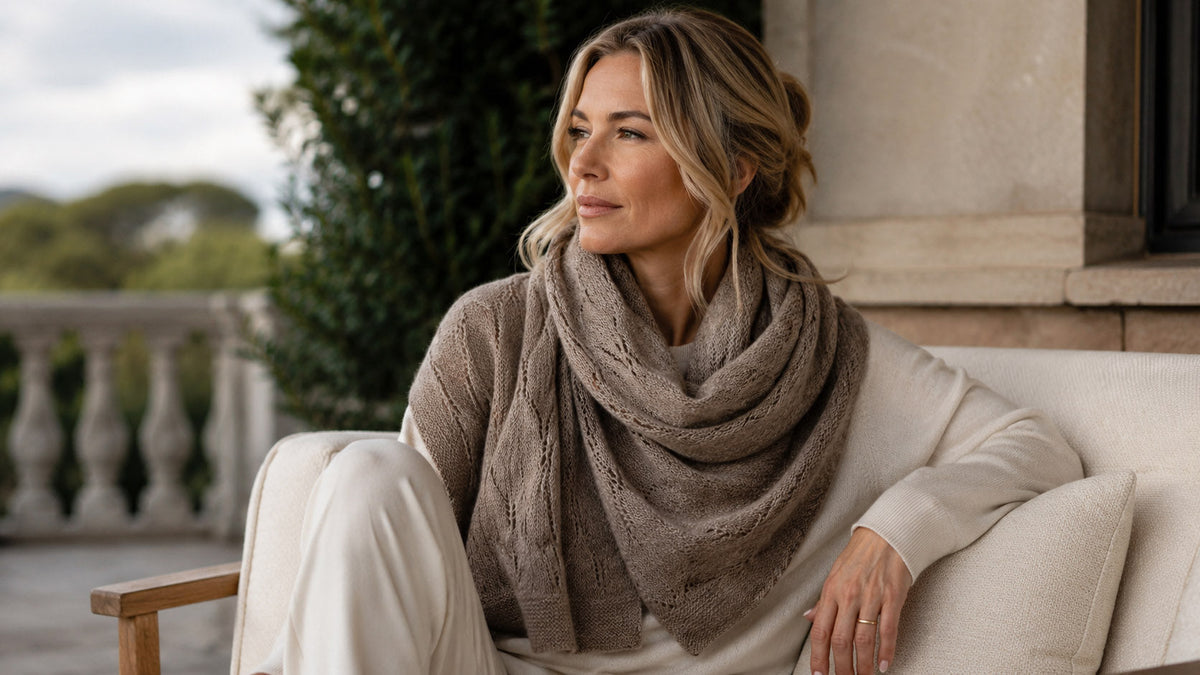
Weave density refers to how tightly the threads are interlocked, and it determines how much air the fabric traps — and therefore how warm it feels. A dense, even weave with minimal light visible when held up to a window produces a scarf that insulates efficiently, drapes smoothly and resists snagging. A looser weave may feel lighter initially, but it wears less evenly and provides less warmth per gram of fiber. For woven scarves, look for a construction that feels firm yet supple — neither stiff nor flimsy. For knitted styles like the Alie lace-knit, the stitches should be uniform in size and spacing throughout.
How Can You Evaluate Quality When Shopping Online?
Without touching the fabric, you rely on specifications, close-up photography, brand transparency and return policy. Look for product pages that state the fiber grade, ply count, weight and fiber origin — brands confident in their quality share these details openly. Examine close-up images: the surface should appear smooth and even, with no visible loose threads. Check whether the brand describes its sourcing — vague language like “premium cashmere” without specifics is often a signal that the details would not impress if disclosed. A generous return policy lets you assess the hand feel yourself, which remains the most reliable test.
The Touch Test: What Good Cashmere Feels Like
When you hold a quality cashmere scarf, the first sensation should be softness without slipperiness. Genuine high-grade cashmere feels warm and dry to the touch, with a gentle spring that returns the fabric to its original shape when you release it. If the surface feels waxy, overly silky or slightly greasy, the fibers may have been chemically treated to simulate softness — a process that washes out over time, leaving the fabric flat and rough.
Scrunch a section gently in your hand and release it. Quality cashmere recovers its shape almost immediately, with minimal creasing. Fabric that stays crumpled suggests either low-grade fibers or a loose, single-ply construction that lacks the resilience to hold its form through regular wear. This simple test tells you more about the scarf than any label can.
Does the Weight of a Scarf Indicate Quality?
Weight alone is not a reliable quality indicator — it reflects dimensions and construction rather than fiber grade. A large shawl will naturally weigh more than a narrow neck scarf regardless of quality. What matters is the weight-to-warmth ratio: a well-made scarf in fine-grade cashmere feels warm relative to how light it is. If a scarf feels heavy without providing proportionate warmth, the fibers may be coarser or the construction less efficient. To understand how weight and ply interact with warmth across seasons, our seasonal warmth guide explains the details.
Finishing Details That Reveal Craftsmanship

Beyond fiber and construction, the finishing of a cashmere scarf tells you how much care went into its creation. Examine the edges — on a well-made woven scarf, hems are neatly rolled or bound, sitting flat without puckering. Fringes, when present, should be securely attached and evenly distributed, not pulling away from the fabric edge. On knitted scarves, the cast-on and cast-off edges should be elastic enough to lie flat without curling.
Look also at the overall surface. Quality cashmere has a uniform appearance — no thin spots, no areas where the weave is noticeably tighter or looser, no inconsistencies in color that suggest uneven dyeing. These details are easy to overlook, but they separate a scarf you enjoy for a season from one that remains a cherished piece for a decade. To understand whether the investment in quality cashmere pays off over time, our cost-per-wear analysis puts real numbers behind the decision. And to see how these quality principles translate into real products, explore our cashmere scarf collection.